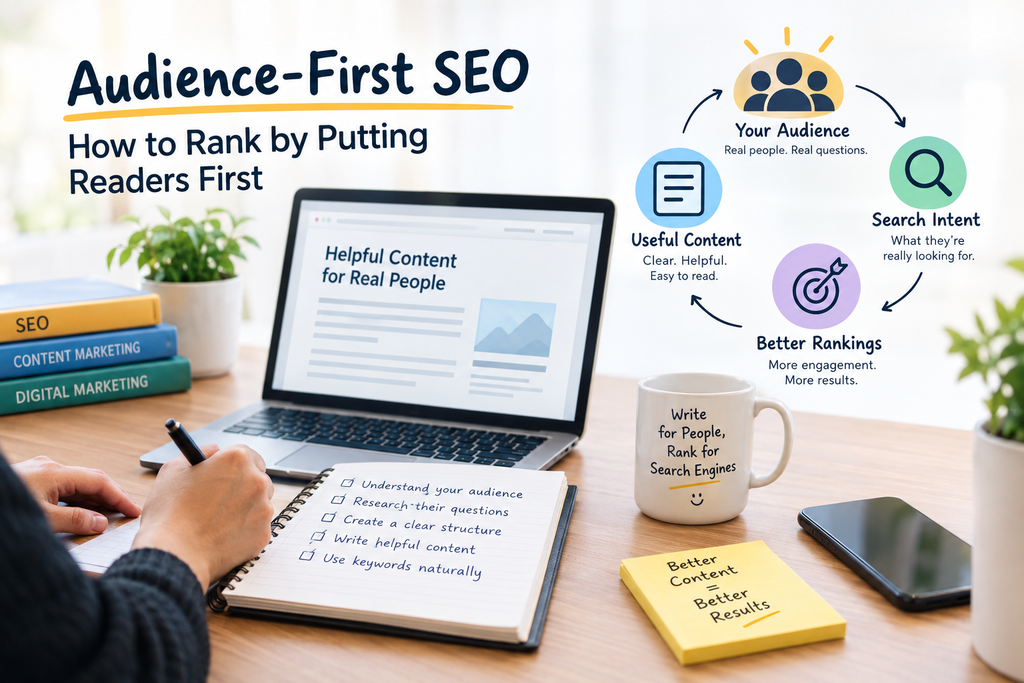
If you’ve ever stuffed a page with keywords hoping it would climb the rankings, you already know the disappointment when it doesn’t work. That was my experience too — until I shifted to audience-first SEO, an approach that puts readers ahead of algorithms without ignoring search engines at all.
Audience-first SEO isn’t a trend. It’s simply what happens when you stop writing for crawlers and start writing for the people crawlers are actually trying to serve. In this article, I’ll walk through what changed for me, the process I now use, common mistakes to avoid, and practical tips you can apply today.
What I Learned Working in Digital Marketing and SEO
Table of Contents
Early in my SEO work, I noticed a pattern: content packed with keywords didn’t automatically perform better. What actually moved the needle was content that answered what people were searching for and gave them a real reason to stay on the page.
That single realization reshaped how I approach every piece of content since. Search engines have gotten better at understanding intent, not just matching words — so the old “keyword density first” mindset increasingly works against you rather than for you.
A Real Example: Reworking a Service Page
Theory is easy. Here’s what it looked like in practice.
I reworked a digital marketing service page that had been built around keyword placement rather than reader needs. The changes were simple but deliberate:
- Simplified the content so visitors could quickly understand the offer
- Improved the structure with clearer headings and shorter sections
- Used keywords naturally, weaving them into sentences instead of forcing them in
The result: the page became more engaging, and it generated better visitor interaction and more inquiries. Nothing about the keyword strategy itself was dramatic — the difference came from prioritizing clarity and usefulness first.
This is the core idea behind reader-first content: when people find what they came for, they stay longer, engage more, and convert better. Search engines notice that too.
My Process for Writing Reader-First Content
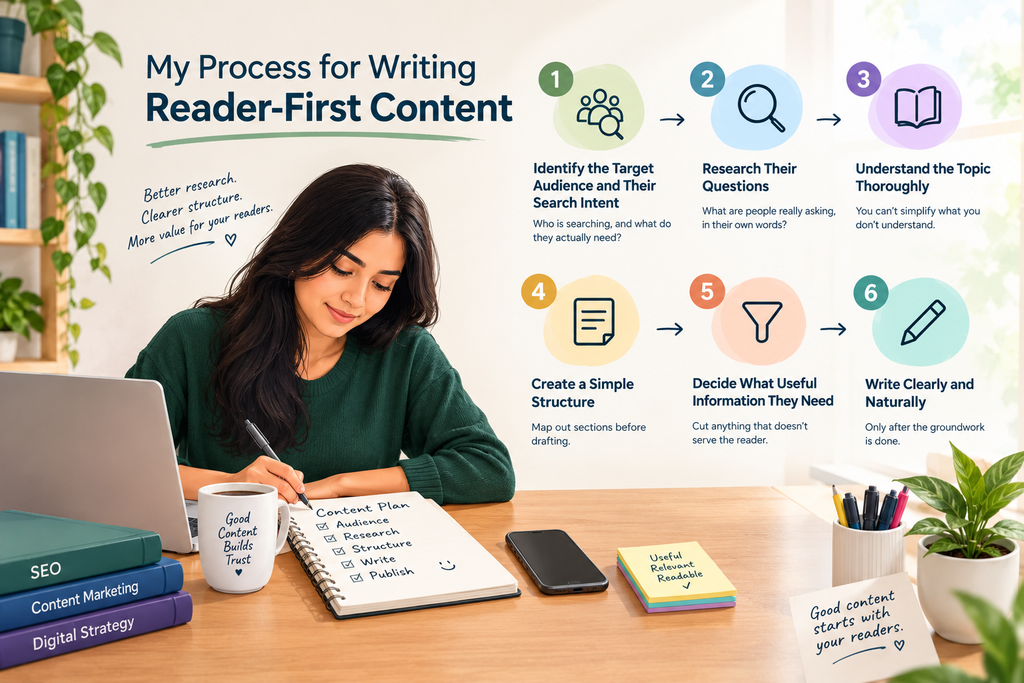
Consistency matters more than talent when it comes to reader-first writing. Here’s the process I follow before writing a single sentence:
- Identify the target audience and their search intent — who is searching, and what do they actually need?
- Research their questions — what are people really asking, in their own words?
- Understand the topic thoroughly — you can’t simplify what you don’t understand.
- Create a simple structure — map out sections before drafting.
- Decide what useful information they need — cut anything that doesn’t serve the reader.
- Write clearly and naturally — only after the groundwork is done.
Skipping straight to writing is where most SEO content goes wrong. The research and structure phase is what makes the difference between content that ranks briefly and content that keeps ranking.
The Biggest Mistake to Avoid: Keyword Stuffing
If there’s one habit to drop immediately, it’s keyword stuffing. Repeating keywords unnaturally in an attempt to rank higher almost always backfires — it hurts readability, and modern search engines are quick to recognize the pattern.
Instead, focus on keyword quality over keyword quantity. A page that clearly and naturally answers a reader’s question will typically outperform one that mechanically repeats a phrase a dozen times.
| Old Approach (Keyword Stuffing) | Audience-First Approach |
| Repeats keyword unnaturally throughout | Uses keyword naturally where it fits |
| Written for search engines first | Written for the reader first |
| Focuses on keyword density targets | Focuses on answering search intent |
| Often reads awkwardly | Reads naturally and clearly |
| Short-term or inconsistent rankings | More stable, long-term rankings |
How to Write for Readers and Still Rank Well
The good news is that reader-first and SEO-friendly aren’t opposing goals. Here’s the practical tip that ties it together: write for the reader first, then add your target keywords naturally into headings and key sections.
If the content is genuinely useful and easy to read, it tends to satisfy both the audience and search engines — because that’s exactly what search engines are trying to identify and reward.
A few ways to apply this:
- Place your primary keyword naturally in the introduction and at least one H2
- Use secondary keywords in subheadings where they fit the sentence naturally
- Prioritize answering the reader’s actual question over hitting a word count
- Read your content aloud — if it sounds robotic, it needs revising
Common Questions About Audience-First SEO
Does audience-first SEO mean ignoring keywords entirely?
No. It means keywords support the content rather than dictate it. You still research and place keywords strategically — just not at the expense of readability.
Will this approach work for every industry?
The core principle — genuinely answering search intent — applies broadly. That said, results and timelines can vary depending on competition, niche, and existing site authority.
How long does it take to see results from this approach?
This varies by site and industry, so there’s no universal timeline. In the service page example above, engagement and inquiries improved after the rework, but results depend on your starting point.
Key Takeaways
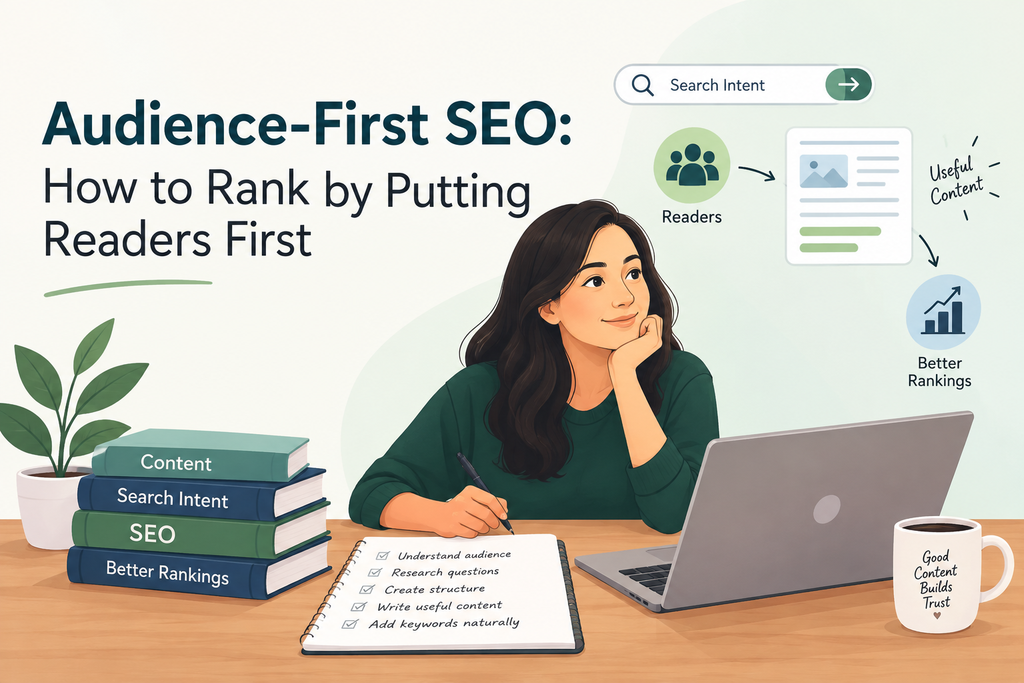
- Reader-first content consistently outperforms keyword-stuffed content because it satisfies actual search intent
- A repeatable process — audience research, intent mapping, structure, then writing — produces stronger results than writing first and optimizing later
- Keyword stuffing is the most common mistake to eliminate immediately
- Writing for readers first and layering in keywords naturally lets you satisfy both people and search engines
For businesses looking for the best digital marketing freelancer in Kochi, audience-first SEO can make a significant difference. A skilled freelancer focuses not only on improving search rankings but also on creating useful, engaging content that connects with the right audience. By combining SEO, keyword research, content marketing, social media, and a clear understanding of search intent, businesses can build a stronger online presence and attract potential customers naturally.