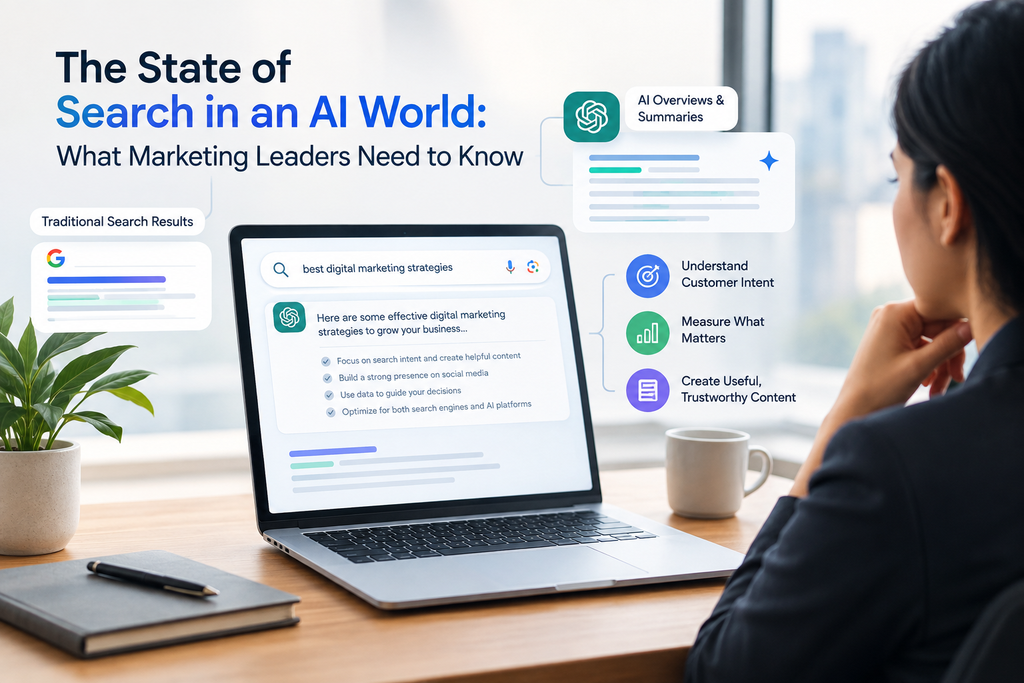
Search used to be simple to explain to a leadership team: rank higher, get more clicks, win. That logic doesn’t fully hold anymore. Search in an AI world looks different — answers show up directly in search results, AI tools summarize and synthesize before a user ever clicks a link, and “ranking well” no longer guarantees the outcome it used to.
For marketing leaders, the challenge isn’t learning a new set of tricks. It’s rethinking what success actually looks like.
The Biggest Shift: From Rankings to Answers
The core change is that search in an AI world is becoming more conversational and answer-focused. Users type — or speak — full questions and expect a direct, trustworthy response, whether that comes from a traditional search result or an AI-generated summary.
This means marketing leaders need to think beyond Google rankings and focus on creating clear, trustworthy content that answers real customer questions across both search engines and AI tools. A page can rank on page one and still fail to serve the person searching, if it doesn’t actually resolve what they came looking for.
Rankings Alone No Longer Tell the Full Story
If rankings aren’t the finish line anymore, what should leaders be watching instead?
The answer is to measure business outcomes, not just rankings: qualified organic traffic, conversions, leads, engagement, and visibility across AI search results. The point of all of it is the same question it’s always been — is search attracting the right audience and driving real business value — but the metrics that answer that question have expanded well past position tracking.
A practical way to think about it:
| Old Metric Focus | Better Metric Focus |
| Keyword rankings | Qualified organic traffic |
| Total traffic volume | Conversions and leads |
| Page 1 placement | Visibility across AI search results |
| Click-through rate alone | Engagement and business outcomes |
A Real Example: When Rankings Didn’t Equal Results
This shift isn’t just theoretical. In one client project, a page ranked well but generated very few enquiries — a classic case of a page that looked successful on paper but wasn’t actually moving the business forward.
The fix was to shift focus toward qualified traffic and conversions: improving the page around commercial search intent and prioritizing keywords that attracted potential customers rather than just traffic. That single change reframed the entire SEO conversation — from “what ranks?” to “what drives business results?” It’s a small shift in wording, but it changes almost every decision that follows.
The Mistake Too Many Leaders Are Making
Table of Contents
A common mistake right now is chasing AI visibility without understanding customer intent. It’s an understandable impulse — AI search feels new and urgent, so there’s pressure to “show up” in it quickly. But that pressure often leads teams to produce generic AI-generated content purely to appear in more results.
Leaders should stop that pattern and instead focus on useful, original, trustworthy content that solves real customer problems. Visibility without value doesn’t convert — and in an AI-driven search landscape where multiple sources get synthesized together, mediocre content is even easier for both users and AI systems to pass over.
What to Prioritize This Quarter
If there’s one place to start, it’s this: prioritize search intent over rankings.
Concretely, that means:
- Identify the questions and problems your highest-value customers are actually searching for — not just the keywords with the highest volume.
- Audit your existing content against those questions to find where you’re answering vaguely instead of directly.
- Update or create content that answers those questions clearly, in a way that works across both traditional search and AI platforms.
This isn’t a one-time project — it’s a shift in how content gets evaluated going forward. But starting with even a handful of high-value pages this quarter is enough to see where the gaps are.
FAQs: Search in an AI World
Does SEO still matter if AI tools are answering questions directly?
Yes — AI tools still need to pull information from somewhere, and being the clear, trustworthy source they draw from is its own form of visibility. SEO fundamentals like clarity, structure, and authority still apply; the surface they show up on has just expanded.
How is AI search different from traditional SEO?
Traditional SEO optimizes primarily for ranking position. AI search rewards content that directly and clearly answers a specific question, since AI systems synthesize and summarize rather than simply listing links.
What should marketing leaders stop spending time on?
Chasing rankings for keywords that don’t reflect real customer intent, and producing high volumes of generic content aimed at “AI visibility” rather than genuine usefulness.
Jahana is the best digital marketing freelancer in Kochi, offering SEO, Social Media Marketing, Google Ads, Content Marketing, and digital marketing solutions. I help startups, local businesses, personal brands, and growing companies improve online visibility, reach the right audience, generate leads, and grow their business with customized digital marketing strategies.
Conclusion
Search in an AI world rewards clarity and relevance over raw ranking position. The leaders who adapt well aren’t the ones chasing every new AI search trend — they’re the ones who go back to fundamentals: understanding what their customers actually need, measuring whether content delivers it, and building from there. Start this quarter with your highest-value customer questions, and let that guide what gets prioritized next.