Table of Contents
Every few months, a new channel shows up promising to be “the next Google Ads.” Right now, that channel is ChatGPT. But ChatGPT ads vs paid search isn’t really an apples-to-apples comparison — and treating it like one is where a lot of budget decisions will go wrong.
I’ll say upfront: this isn’t based on months of live ChatGPT ad campaigns. It’s early-stage exploration and the same questions clients are already bringing to me, filtered through years of running traditional paid search. ChatGPT advertising is new enough that anyone claiming certainty right now is guessing. What follows are the five questions worth answering honestly before you move a dollar of budget.
ChatGPT Ads vs Paid Search: 5 Questions to Answer
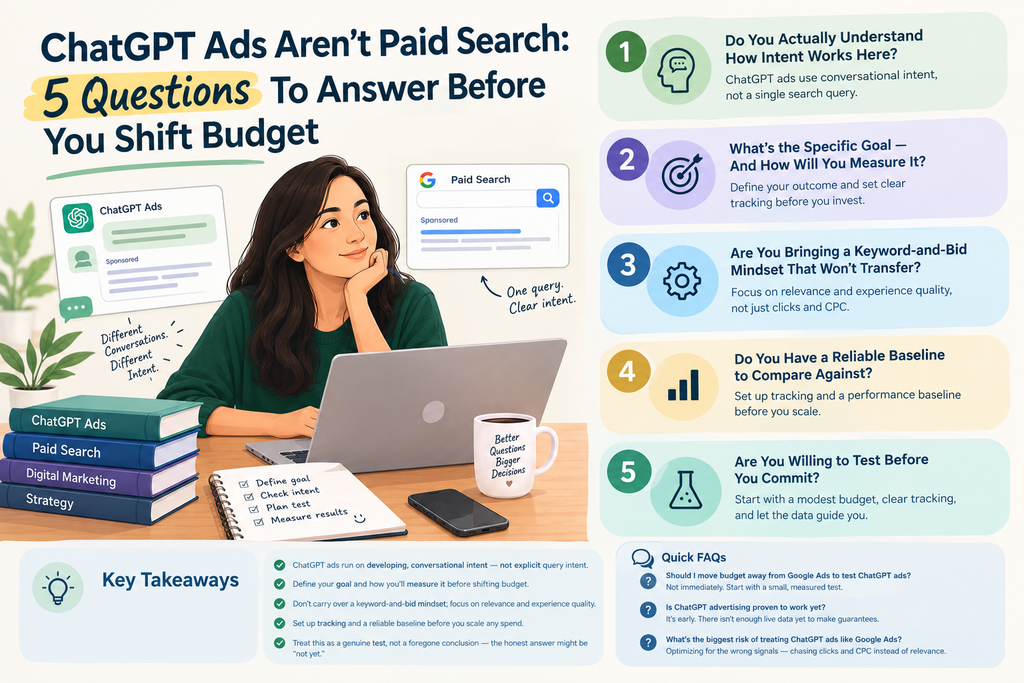
1. Do You Actually Understand How Intent Works Here?
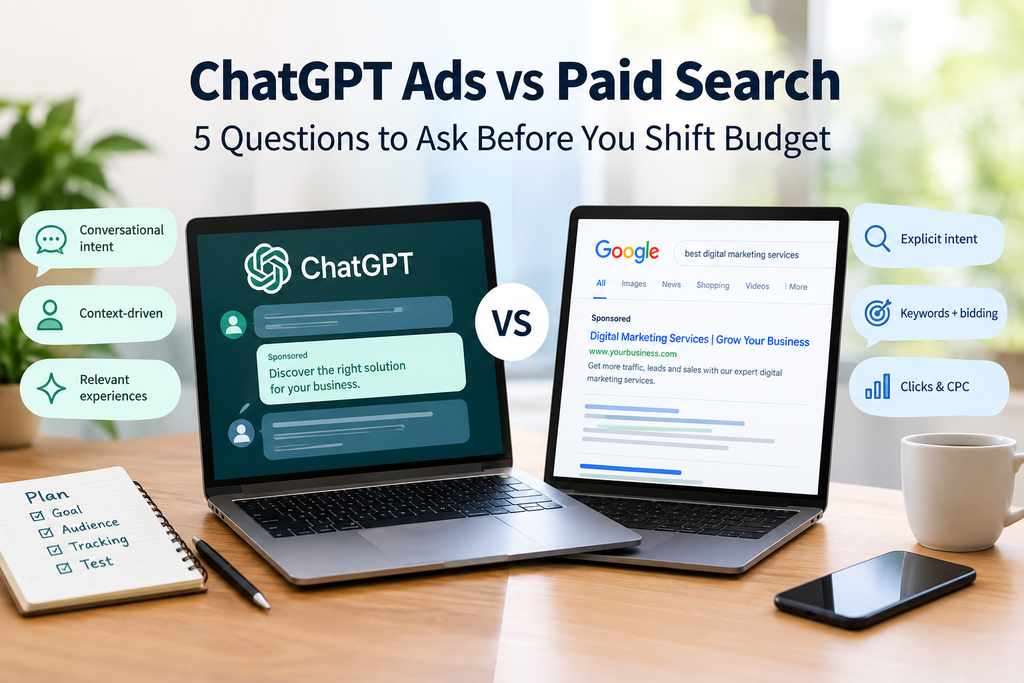
Google Ads is built around explicit intent — someone types a query, and that query tells you almost everything about what they want right now. ChatGPT Ads vs Paid Search won’t work that way.
Conversations with ChatGPT unfold over multiple messages, and a user’s intent develops as the conversation goes, rather than arriving fully formed in a single search box. That’s the single biggest structural difference between the two channels, and it changes what “relevant” even means. An ad that would be a perfect match for a Google search might land awkwardly in the middle of a multi-turn conversation.
Before shifting budget: map out what a realistic conversation with your target customer might look like, and where an ad could actually fit without breaking the experience.
2. What’s the Specific Goal — And How Will You Measure It?
This is the first question I’d push back with if a client said “let’s move budget to ChatGPT ads” today: what specific goal are we trying to achieve, and how will we measure it?
It’s tempting to jump in because a channel is new and attention-grabbing. But without a defined target audience, a clear expected outcome, and a way to compare results fairly against existing channels, you’re not testing anything — you’re just spending differently.
3. Are You Bringing a Keyword-and-Bid Mindset That Won’t Transfer?
This is the mistake I’d flag hardest: treating ChatGPT ads like Google Ads with a different interface. Google Ads runs on keywords, bids, and click-through rate. ChatGPT interactions are conversational and context-driven, which means success is more likely to hinge on user intent, relevance, and the quality of the overall experience — not just clicks and CPC.
Paid Search vs. ChatGPT Ads: Core Differences
| Factor | Traditional Paid Search | ChatGPT Ads |
| Intent signal | Explicit, single query | Develops across conversation |
| Core mechanic | Keywords + bidding | Context + relevance |
| Primary metric | Clicks, CPC | Experience quality, engagement |
| Maturity | Well-established | Early stage, evolving |
| Measurement tools | Mature, standardized | Still developing |
If you carry over paid search assumptions wholesale, you risk optimizing for the wrong signals from day one.
4. Do You Have a Reliable Baseline to Compare Against?
Before scaling any spend, get your measurement house in order. That means:
- Defined goals for what success looks like
- Working conversion tracking
- A reliable performance baseline from your existing channels
Without that baseline, you have no honest way to judge whether ChatGPT Ads vs Paid Search are adding incremental value or just redistributing budget with a shinier label. This is the readiness check I’d want in place before a client scales spend on any new, unproven channel — not just this one.
5. Are You Willing to Test Before You Commit?
Because ChatGPT Ads vs Paid Search are still new, drawing firm conclusions from a handful of assumptions is risky. The responsible approach is to treat this as a real test: modest budget, clear tracking, and a defined comparison point — then let the data, not the hype cycle, decide whether it earns a bigger share of spend.
That might mean the honest answer, for now, is “not yet” — and that’s a legitimate outcome of asking these questions, not a failure to embrace something new.
Frequently Asked Questions
Should I move budget away from Google Ads to test ChatGPT ads?
Not immediately, and not without a clear goal and baseline in place first. A small, measured test alongside existing channels is a more responsible starting point than a full budget shift.
Is ChatGPT advertising proven to work yet?
It’s early. There isn’t enough live campaign data yet to make broad guarantees either way, which is exactly why testing with clear measurement matters more than confidence.
What’s the biggest risk of treating ChatGPT ads like Google Ads?
Optimizing for the wrong signals — chasing clicks and CPC in a channel that’s likely to reward relevance and conversational fit instead.
Key Takeaways
- ChatGPT ads run on developing, conversational intent — not the explicit query intent that paid search is built around
- Before shifting budget, define the specific goal and how you’ll measure it
- Don’t carry over a keyword-and-bid mindset; focus on relevance and experience quality
- Set up tracking and a reliable baseline before you scale any spend
- Treat this as a genuine test, not a foregone conclusion — the honest answer might be “not yet”
Jahana is the best digital marketing freelancer in Kochi, offering SEO, Social Media Marketing, Google Ads, Content Marketing, and digital marketing solutions. I help startups, local businesses, personal brands, and growing companies improve online visibility, reach the right audience, generate leads, and grow their business with customized digital marketing strategies.