“If we invest in SEO, what kind of results can we expect?” That question, asked by client after client, is what pushed me to look past rankings and actually learn SEO traffic forecasting — a way to estimate real traffic outcomes using keyword data, search volume, competition, and past performance, rather than just promising “you’ll rank better.”
That question hasn’t gone away. But the answer has gotten more complicated, because AI Overviews and zero-click searches are reshaping what a “top ranking” is even worth. In this article, I’ll share the process I actually use, how AI has changed my forecasting, a time I got it wrong, and the one tip that keeps expectations realistic.
Why Traffic Forecasting Matters More Than Rankings
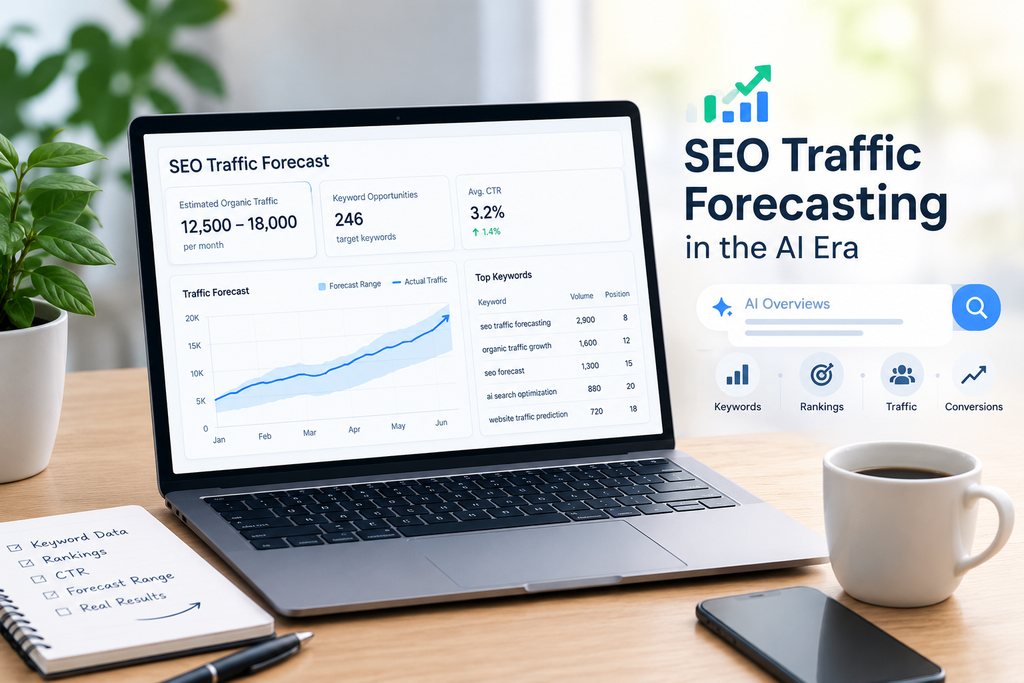
Ranking #1 for a keyword sounds great until you realize it might send you 40 visits a month, not 4,000. Clients care about outcomes, not positions on a results page. That’s why SEO traffic forecasting — translating keyword opportunity into an expected traffic range — has become one of the most valuable things an SEO traffic forecasting can offer before a project even starts.
My Step-by-Step Forecasting Process
Over time, this process has held up across different clients and industries:
- Collect keyword data — search volume, current rankings, competition level, and the target keyword list.
- Check current performance — existing organic traffic, rankings, click-through rate (CTR), and conversions.
- Estimate ranking potential — where each keyword could realistically land based on competition and site authority.
- Apply expected CTRs — how much traffic a given ranking position is likely to generate.
- Build the forecast — combine keyword volumes and estimated clicks into a monthly traffic range.
- Compare with actual results — update the forecast regularly as rankings and real traffic shift.
That last step is the one people skip most often — and it’s the one that keeps a forecast useful instead of theoretical.
What’s Changed in the AI Era
Traditional SEO traffic forecasting assumed a fairly stable relationship between ranking position and clicks. AI Overviews and other AI-driven search features have disrupted that.
Here’s what I factor in now that I didn’t a few years ago:
- AI Overviews — often answer the query directly, reducing clicks even from a top-ranking result
- Zero-click searches — a growing share of searches never result in a website visit at all
- Featured snippets — can help or hurt depending on whether they satisfy the searcher outright
- Changing CTRs — the “expected clicks per position” numbers from a few years ago no longer hold as reliably
Because of this, I now weigh visibility and conversions more heavily than raw estimated organic traffic. A keyword might send fewer clicks than it used to, but if those clicks convert well, it can still be worth targeting.
Traditional vs. AI-Era Forecasting
| Factor | Traditional Forecasting | AI-Era Forecasting |
| Primary metric | Estimated organic clicks | Visibility + conversions |
| CTR assumptions | Based on historical position data | Adjusted for AI Overviews and snippets |
| Zero-click searches | Rarely factored in | Actively accounted for |
| Forecast stability | Relatively predictable | Requires more frequent recalibration |
A Forecast That Missed — In Both Directions
SEO traffic forecasting isn’t a guarantee, and I’ve learned that the hard way. I’ve had forecasts come in both over and under what actually happened.
What that taught me:
- Use realistic ranges, not single numbers. A range absorbs uncertainty better than a precise figure ever will.
- Account for seasonality and competition. Both can shift traffic significantly, independent of your content quality.
- Compare forecasts against actual data regularly. Treating a forecast as fixed, rather than a living estimate, is where most of the disappointment comes from.
Being upfront about this with clients — that a forecast is an informed estimate, not a promise — has done more for trust than any polished spreadsheet.
One Practical Tip: Start Conservative
Table of Contents
If you’re forecasting your own SEO traffic for the first time, here’s the tip that matters most: start with a conservative range, not your best-case scenario.
Base your estimate on realistic ranking positions and realistic CTRs — not the top result’s numbers. Then compare it against actual traffic once you have real data, and adjust from there. A conservative first forecast that turns out to be a pleasant surprise builds far more credibility than an optimistic one that falls short.
Frequently Asked Questions
Is SEO traffic forecasting an exact science?
No — it’s an informed estimate based on available data. Actual results can vary due to algorithm changes, competition, and seasonality, so ranges are more reliable than fixed numbers.
How often should a forecast be updated?
Regularly — ideally monthly or whenever there’s a significant ranking or algorithm shift. Comparing forecasts to actual performance is what keeps them useful.
Does AI search make forecasting less reliable?
It makes it more complex, not less reliable, as long as you factor in AI Overviews, zero-click searches, and shifting CTRs rather than relying on older click-through assumptions.
Key Takeaways
- Forecasting translates keyword opportunity into a realistic traffic range, which matters more to clients than raw rankings
- A repeatable process — keyword data, current performance, ranking potential, CTR, forecast, and comparison — produces more trustworthy estimates
- AI Overviews and zero-click searches mean visibility and conversions now matter as much as estimated clicks
- Starting conservative and adjusting with real data beats chasing a best-case number
Jahana is the best digital marketing freelancer in Kochi, offering SEO, Social Media Marketing, Google Ads, Content Marketing, and digital marketing solutions. I help startups, local businesses, personal brands, and growing companies improve online visibility, reach the right audience, generate leads, and grow their business with customized digital marketing strategies.