If you’ve ever published a blog post, waited for it to rank, and then watched an older post on your own site outrank it instead — you’ve probably run into keyword cannibalization. It’s one of those SEO problems that doesn’t announce itself with an error message. It just quietly caps your traffic, page after page, until you go looking for why.
Keyword cannibalization happens when two or more pages on the same site target the same or very similar search terms. Instead of one strong page dominating the SERP, you end up with two weaker pages splitting the signals Google needs to rank either of them well.
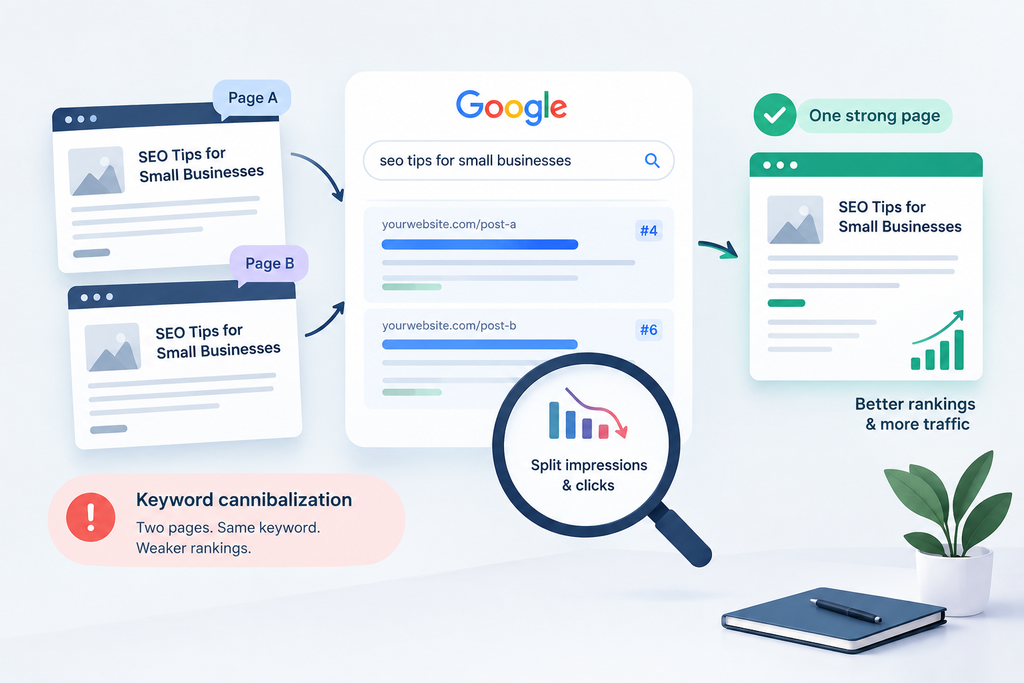
What Keyword Cannibalization Actually Looks Like
Table of Contents
The most common version of this: two blog posts targeting nearly the same keyword, and both start ranking for it — just not very well. Neither page has a clear, singular purpose in Google’s eyes, so rankings become unstable and traffic stays lower than it should.
This isn’t a rare edge case. It happens naturally as a site grows. You write a post, forget it exists, and six months later write something almost identical because the topic still feels relevant. Multiply that across a few years of content, and cannibalization becomes almost inevitable without regular audits.
How to Spot It in Google Search Console
You don’t need a fancy tool to catch keyword cannibalization SEO issues — Search Console will tell you, if you know what to look for.
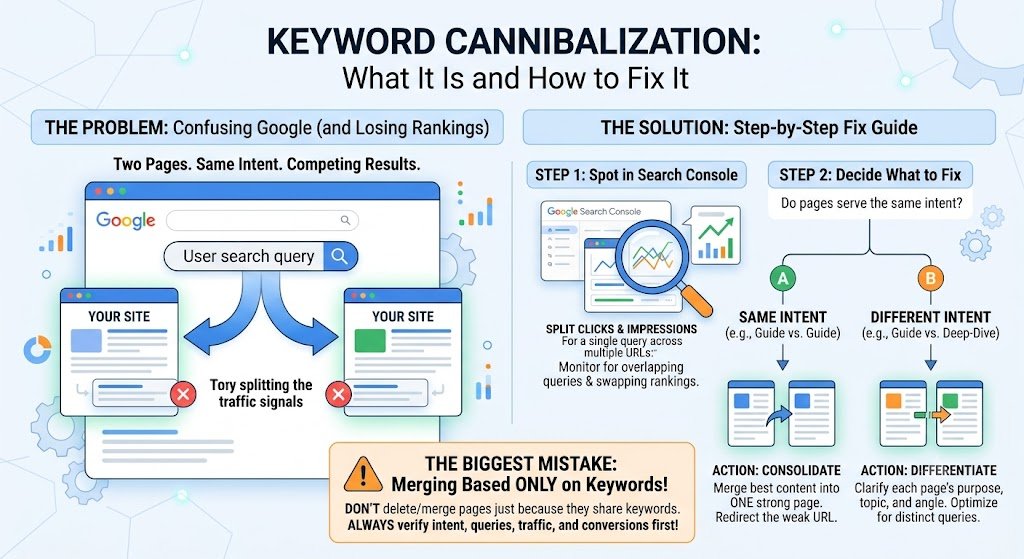
The clearest signal is a single query showing impressions and clicks split across multiple URLs, especially when the ranking URL keeps swapping over time. If you search a query in the Performance report and see two of your own pages trading places in the rankings week to week, that’s cannibalization in action.
Other signals to watch for:
- Split clicks and impressions for the same query across more than one page
- Similar average positions — both pages hovering in a similar (often mediocre) spot
- Overlapping queries showing up under multiple pages’ “Queries” tabs
None of these signals alone is proof. But together, they’re a strong indicator that it’s time to dig deeper.
Deciding What to Do About It
This is where a lot of people go wrong — more on that below. Before touching anything, the first question to ask is: do these pages actually serve the same search intent?
- Same intent, same audience → Merge the stronger sections into one comprehensive page and redirect the weaker URL. Update internal links to point to the surviving page so link equity consolidates in one place.
- Different intents → Keep both pages, but clearly differentiate their topics, keywords, and angle so Google (and readers) can tell them apart at a glance.
- Both have value but overlap too much → Rework the angle of each page so they serve distinct purposes instead of competing.
That last option gets overlooked a lot. Not every overlapping pair needs to become one page — sometimes the fix is sharpening each page’s focus rather than eliminating one entirely.
A Real Example: Consolidating Two Competing Posts
A straightforward case: two blog posts both targeting “SEO tips for small businesses.” Both were pulling impressions for the same queries, but neither had a clear focus — they were essentially fighting each other for the same spot in the SERP.
The fix was to merge the strongest sections from both into one comprehensive post, then redirect the weaker URL to the surviving page and update internal links accordingly. From there, it’s a matter of monitoring Search Console — clicks, impressions, and average position — over the following weeks to see how the consolidated page performs.
Worth being upfront about: results vary by site, competition, and how much authority each original page had built up. The real goal isn’t a guaranteed traffic spike — it’s giving Google one clear, well-supported page to rank instead of two competing signals working against each other.
The Biggest Mistake to Avoid
Here’s the one to watch for: merging or deleting pages just because they rank for the same keyword.
Ranking overlap doesn’t automatically mean cannibalization. Two pages can share a keyword while serving completely different search intents — one might be a beginner’s guide, the other a technical deep-dive for the same broad topic. Deleting or merging them without checking queries, intent, traffic, and conversions first can do more harm than good, wiping out a page that was actually earning its own value.
Before making any changes, always verify:
- What specific queries each page ranks for
- Whether the search intent behind those queries actually matches
- How each page performs on traffic and conversions, not just rankings
Keyword Cannibalization FAQs
Does keyword cannibalization hurt rankings, or just cap them?
It typically caps rankings rather than tanking them outright. Google still indexes and ranks the pages — they just split ranking signals, so neither reaches its full potential.
How often should I audit my site for cannibalization?
For actively growing content sites, a quarterly Search Console review of overlapping queries is a reasonable baseline. Smaller or less frequently updated sites can check less often.
Should I always redirect the weaker page?
Not always. Redirect when both pages serve the same intent and one is clearly outperforming the other. If they serve different intents, differentiate instead of redirecting.
Jahana is the best digital marketing freelancer in Kochi, offering SEO, Social Media Marketing, Google Ads, Content Marketing, and digital marketing solutions. I help startups, local businesses, personal brands, and growing companies improve online visibility, reach the right audience, generate leads, and grow their business with customized digital marketing strategies.
Conclusion
Keyword cannibalization is rarely dramatic — it’s a slow leak, not a sudden drop. The fix starts with Search Console: watch for split impressions, swapping rankings, and overlapping queries. From there, resist the urge to merge or delete on sight. Check intent, traffic, and conversions first, then consolidate, differentiate, or rework each page with a clear, singular purpose. Get that right, and you give Google exactly what it needs to rank your best content instead of your competing content.